


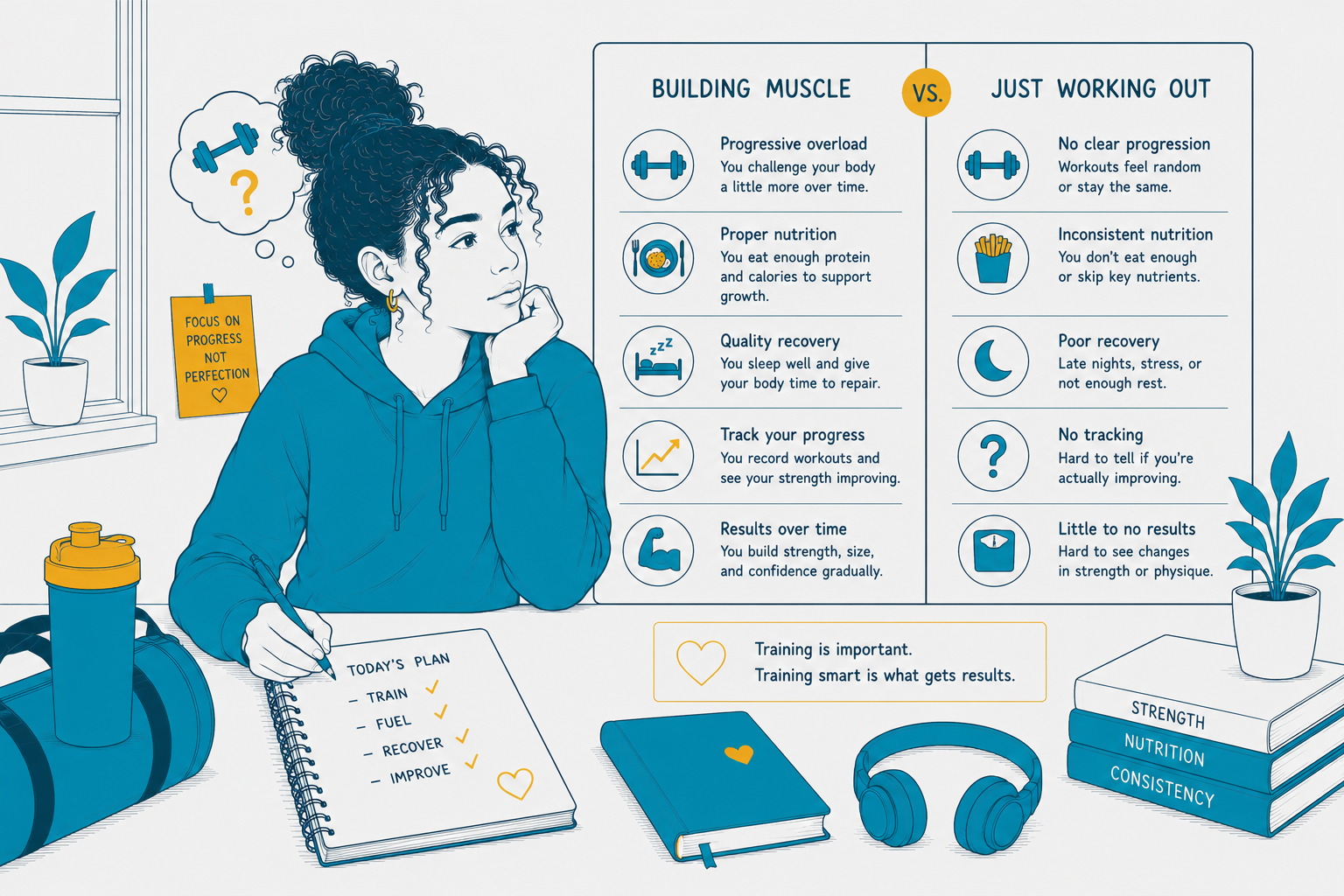
One of the more frustrating parts of beginner fitness is that progress does not always announce itself clearly.
You start training, try to stay consistent, and eventually find yourself asking a surprisingly difficult question:
Is anything actually happening?
That uncertainty can be uncomfortable, particularly when your goal involves visible muscle gain. You want signs that the effort is leading somewhere, but beginner progress does not always arrive in one obvious form or on one predictable timeline.
If you are looking for the broader picture around muscle-building timelines, our How Long Does It Take to Build Muscle? (Beginner Timeline) guide explores the wider topic. This article focuses on something narrower: how beginners sometimes recognise muscle-building progress, and why the answer is often more nuanced than simply checking the mirror every few days.
Visible Muscle Gain Is Not The Only Way Progress Shows Up
A lot of people begin strength training with a fairly straightforward expectation.
You work out consistently, muscle appears, and the results become increasingly obvious.
Real-life progress can feel more ambiguous than that.
Visible changes matter to many beginners, particularly if muscle building is one of the main goals. At the same time, visible development is not always the first signal people notice.
Early progress can sometimes appear through changes in training experience.
Exercises that once felt awkward begin feeling more familiar. Gym sessions become less overwhelming. Certain movements start feeling stronger, smoother, or easier to organise inside your routine.
Those experiences are not identical to visible muscle growth.
They can, however, provide useful clues that your training experience is changing rather than standing completely still.
If you are currently feeling unsure about slow or unclear results, Why You’re Not Seeing Muscle Gain Yet explores some of the reasons beginners sometimes struggle to interpret their progress.
Strength Changes Can Be One Piece Of The Picture
One of the more common questions beginners ask is whether getting stronger automatically means muscle is being built.
The honest answer is slightly more nuanced than a simple yes or no.
Strength improvements can sometimes form part of the wider progress picture. You may notice certain exercises feeling more controlled, weights becoming more manageable, or movements requiring less hesitation than they did earlier in your routine.
That does not automatically mean every small strength change guarantees obvious muscle development.
However, beginners sometimes dismiss strength progress too quickly because it does not perfectly match the outcome they are measuring most closely.
This is one reason fitness progress can feel confusing during the early stages.
Different kinds of improvement do not always appear at the same speed.
If you are curious about how performance progress and visible size changes sometimes relate to one another, Strength vs Size: What Progress Comes First? explores this relationship in more detail.
The Mirror Can Be A Surprisingly Complicated Measurement Tool
Many beginners naturally use appearance as their primary progress tracker.
That makes sense.
If muscle building is your goal, looking for visual changes is a fairly understandable instinct.
The difficulty is that visual assessment can become surprisingly inconsistent.
You see yourself regularly.
Small changes may develop gradually.
Expectations, lighting, mood, comparison habits, and day-to-day perception can all influence how progress feels when you are trying to judge it through quick visual checks.
That does not mean appearance is irrelevant.
It simply means that relying on one measurement method alone can sometimes make progress feel more confusing than it actually is.
Progress Often Feels Clearer In Retrospect Than In Real Time
One of the quieter realities of beginner fitness is that progress sometimes becomes easier to recognise after a longer period of consistency than people initially expect.
When changes happen gradually, day-to-day observation can make development feel subtle or unclear. Looking for dramatic confirmation every few days can sometimes create the impression that nothing meaningful is changing, even when your routine, confidence, or performance are developing gradually underneath the surface.
That is part of why beginners occasionally experience a strange moment of hindsight.
You feel stuck for weeks — then realise certain exercises feel easier, workouts feel more organised, or aspects of your training no longer feel as unfamiliar as they once did.
Progress does not always feel dramatic while it is unfolding.
Comparing Yourself To Dramatic Results Can Distort How You Read Your Own Progress
One challenge in modern fitness is that people often measure their progress against outcomes that were never particularly realistic reference points to begin with.
Transformation photos, dramatic timelines, edited gym content, and rapid-looking success stories can quietly influence what muscle-building progress is “supposed” to look like.
That comparison matters because it shapes interpretation.
If you expect dramatic visual change quickly, more gradual forms of progress can start feeling inadequate or invisible by comparison.
- Workouts feeling smoother does not count
- Strength improvements do not count
- Routine confidence does not count
- Only obvious appearance changes feel convincing enough to qualify as proof
That mindset can make it surprisingly difficult for beginners to recognise development that does not match a highly specific mental picture of success.
If you are currently trying to understand what realistic beginner timelines often look like, Realistic Muscle Growth Timeline for Teens (What to Expect) explores why muscle progress can feel slower and less dramatic than people sometimes expect.
Consistency Can Become A Progress Signal In Its Own Right
During the early stages of fitness, it is easy to focus almost entirely on visible outcomes.
You look for muscle changes, clearer definition, or obvious physical signs that training is working. In the process, quieter forms of progress can become easy to overlook.
For many beginners, starting a routine does not immediately feel smooth or natural. Exercises may feel unfamiliar, gym environments can create uncertainty, and workouts often require more mental effort than people expect. Simply figuring out what to do, how to do it, and how to move through a session confidently can take time.
As routines develop, some people notice that parts of the experience begin feeling more manageable. Workouts become easier to organise, exercises involve less second-guessing, and training gradually demands less mental energy than it did at the beginning.
That does not automatically confirm visible muscle growth.
At the same time, growing consistency, increased routine familiarity, and stronger training confidence can provide useful context when you are trying to understand whether your fitness experience is moving forward, even when physical changes still feel difficult to judge.
Progress Tracking Does Not Need To Become An Obsession
When beginners feel uncertain about muscle gain, there can be a temptation to measure everything.
- Constant mirror checks
- Frequent comparisons
- Endless analysis of whether progress looks convincing enough yet
Usually, that approach does not create much clarity.
It often creates more confusion.
Paying attention to progress is understandable.
Becoming trapped in constant progress surveillance is a different experience.
For many teenagers and young adults, a more useful question is not whether you can prove dramatic change every few days. It is whether your training experience feels different, more familiar, or more developed than it did earlier in your routine.
That perspective does not remove every uncertainty around muscle building.
It can sometimes make progress feel slightly easier to interpret.
Muscle Building Progress Is Not Always Easy To Judge In Real Time
Part of the difficulty is that beginner progress rarely unfolds with perfect clarity.
Different forms of development can move at different speeds.
Visible changes may feel subtle.
Strength confidence may improve more noticeably.
Routine familiarity may develop quietly in the background.
Because of that, beginners sometimes search for one single signal that confirms everything is working.
Real experiences are often more layered than that.
Progress can involve a mixture of physical, behavioural, and confidence-related changes that become easier to understand when viewed together rather than judged through one measurement method alone.
If you want to explore some of the factors that can influence how quickly progress feels noticeable, What Slows Down Muscle Growth in Beginners explores areas that beginners sometimes underestimate.
Looking For One Perfect Sign Of Progress Can Make Things More Confusing
When beginners feel uncertain about muscle gain, there is often a strong temptation to find one clear measurement that settles the question.
- A visible change in the mirror
- A particular number in the gym
One moment that proves the routine is definitely working.
The difficulty is that beginner progress does not always organise itself that neatly.
Different forms of development can appear at different times. Visible changes may feel subtle, while confidence, exercise familiarity, or performance changes become easier to notice first. In other situations, physical changes may feel more noticeable than shifts in training confidence.
That variability is part of what makes muscle building feel difficult to judge in real time.
Searching for one perfect signal can sometimes make progress feel more confusing rather than more understandable.
Understanding Progress Often Requires A Wider View
For many teenagers and young adults, a more useful question is not simply:
“Can I prove dramatic muscle gain right now?”
It is something slightly broader.
“Does my training experience feel different from when I started?”
That wider perspective does not mean lowering expectations or pretending visible outcomes no longer matter.
It means recognising that beginner development often involves multiple changes unfolding together.
Workouts may feel more structured than they did originally. Exercises can become more familiar. Training may require less hesitation or mental effort than it did during the first few weeks of building a routine.
Those experiences are not identical to visible muscle growth.
They can, however, provide useful context when you are trying to understand whether your fitness experience is evolving rather than standing completely still.
If you want to explore some of the factors that can influence how quickly muscle progress feels noticeable, What Slows Down Muscle Growth in Beginners explores several areas beginners sometimes underestimate.
Final Thoughts
Knowing whether you are actually building muscle can feel surprisingly complicated during the beginner stage.
Visible changes matter to many people, but they are not always the only sign that training is developing in a meaningful way. Strength improvements, routine familiarity, exercise confidence, and growing consistency can sometimes provide useful clues when progress feels difficult to judge through appearance alone.
That does not mean every routine is automatically producing muscle growth, and it does not mean frustration around slow or unclear results is invalid.
It does suggest that beginner progress is often broader, slower, and more layered than many people expect.
Understanding that can make the process feel a little less confusing while you continue building experience, confidence, and perspective around your own training journey.