

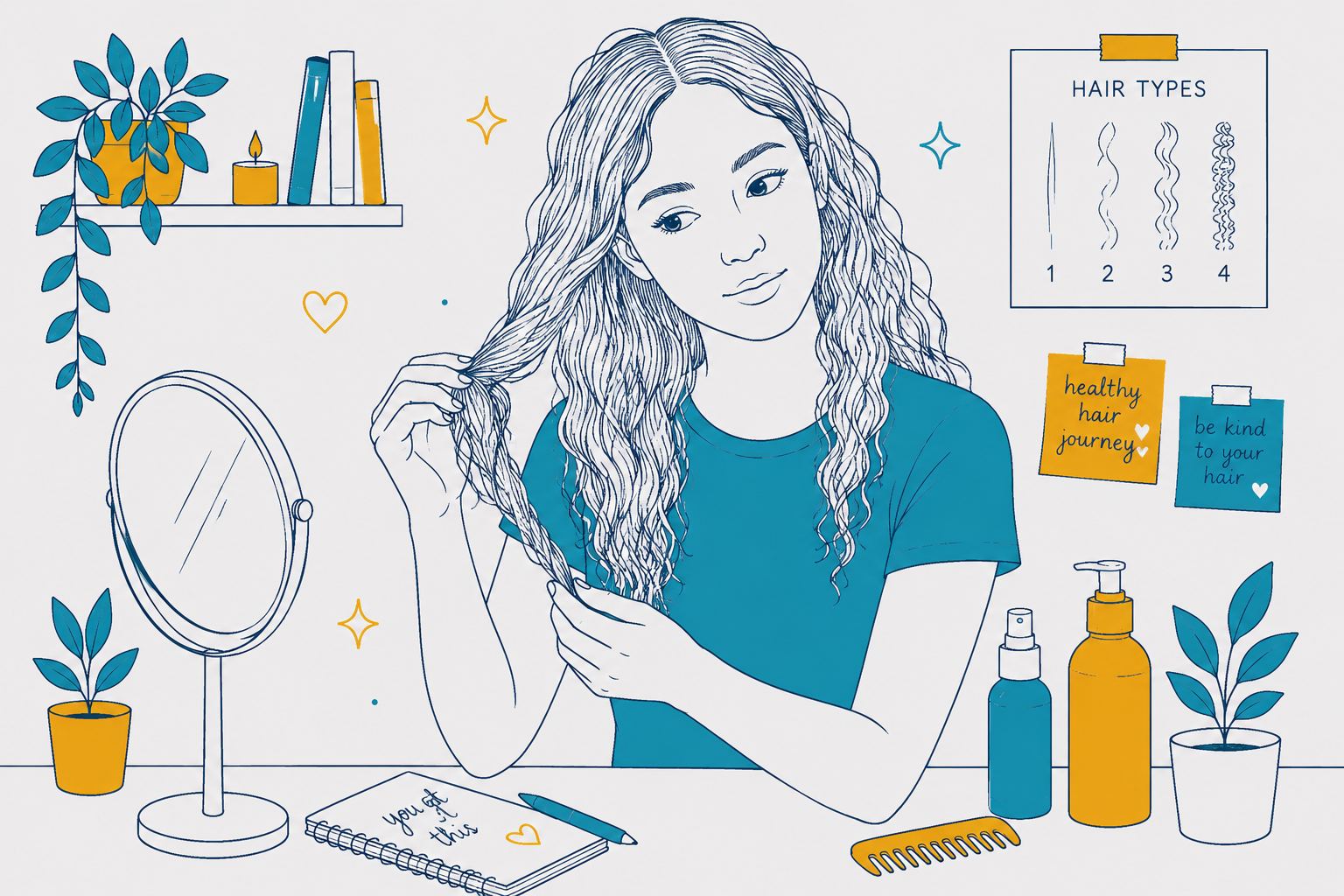

Choosing the right shampoo, conditioner, and styling products becomes much easier when you understand your hair type. The problem is that many teenagers are never actually taught how to work out what their hair type is. Instead, they often rely on trial and error, online recommendations, or products designed for completely different hair needs.
If you’re trying to choose products that suit your hair, our Choosing the Right Shampoo & Conditioner for Your Hair Type guide explores the bigger picture. This article focuses on one specific question: how to identify your own hair type and why it matters.
The good news is that hair type is usually easier to understand than many people think. You do not need specialist equipment or expert knowledge. You simply need to pay attention to how your hair naturally behaves.
What Do People Mean by “Hair Type”?
When people talk about hair type, they are often referring to several different characteristics rather than one single thing.
These include:
- Hair texture (straight, wavy, curly, or coily)
- Hair thickness (fine, medium, or thick)
- Scalp type (oily, dry, sensitive, or combination)
All three can influence which products feel most comfortable and effective.
For example, two people may both have straight hair, but one might have a dry scalp while the other has an oily scalp. Their routines may need to be quite different despite having similar-looking hair.
This is one reason product recommendations can sometimes feel confusing. What works brilliantly for one person may not suit somebody else with different hair characteristics.
Understanding Hair Texture
Hair texture is usually the easiest place to start.
Look at your hair after washing and allowing it to dry naturally without heavy styling products or heat tools.
- If your hair dries mostly straight with little visible bend, it is likely straight.
- If it develops loose bends or soft “S” shapes, it is probably wavy.
- If you notice more defined spirals, loops, or ringlets, your hair is likely curly.
- If the curls are very tight, densely packed, or form coils, your hair may be coily or tightly textured.
The important thing to remember is that texture exists on a spectrum.
Many people do not fit neatly into a single category.
You may have looser waves in some areas and tighter curls in others. That is completely normal.
Understanding Hair Thickness
Hair thickness refers to the individual strands themselves rather than the amount of hair you have.
Fine hair strands are usually smaller in diameter and can sometimes feel softer or become weighed down by heavy products.
Medium hair tends to sit somewhere in the middle and often tolerates a wider variety of products.
Thick hair strands are generally larger and may benefit from richer products that provide additional moisture and manageability.
One simple way to think about thickness is to consider how your hair typically responds to products.
If products seem to make your hair greasy or heavy very quickly, fine hair may be a factor. If your hair absorbs products easily and still feels dry, thicker strands may be part of the reason.
Understanding thickness can make product selection much easier than simply focusing on texture alone.
Understanding Your Scalp Type
Many people focus entirely on the hair itself and forget about the scalp.
However, scalp type often plays a major role in deciding which shampoo works best.
If your hair becomes oily quickly after washing, you may have a naturally oilier scalp.
If your scalp often feels tight, dry, itchy, or uncomfortable, it may lean towards dryness.
Some people experience sensitivity and find that certain products easily cause irritation.
Others have a combination scalp, where some areas become oily while others feel dry.
If you’re struggling to choose products, understanding your scalp can be just as important as understanding your hair texture.
In fact, many shampoo decisions are based more on scalp needs than hair appearance.
Why Your Hair Type Can Change
One reason teenagers often feel confused about their hair is that it does not always stay exactly the same.
Puberty can affect oil production, which may change how quickly hair becomes greasy. Hormonal changes can influence hair behaviour, and styling habits can also affect how hair looks and feels over time.
This means that a routine that worked perfectly when you were younger may no longer feel quite right.
That does not necessarily mean anything is wrong.
It simply means your hair may have different needs than it did previously.
Understanding this can make it easier to adjust your routine without feeling like you are constantly doing something incorrectly.
Why Product Recommendations Don’t Always Work
It is tempting to assume that if a product works for a friend, influencer, or family member, it should work for you too.
Unfortunately, hair care is rarely that simple.
People can have very different combinations of texture, thickness, scalp type, styling habits, and environmental conditions. A shampoo designed for someone with thick, dry curls may feel completely wrong for someone with fine hair and an oily scalp.
This is one reason many people end up buying products that receive excellent reviews but produce disappointing results.
Our article on why hair products work differently for everyone explores why individual differences often matter more than product popularity.
Understanding your own hair usually provides more useful information than following somebody else’s routine exactly.
Hair Type Is a Guide, Not a Label
One mistake people sometimes make is treating hair type like a fixed identity.
In reality, it is simply a tool.
The purpose of understanding your hair type is not to place yourself into a category. It is to help you make more informed decisions about products, washing frequency, styling methods, and hair care habits.
You do not need to analyse every strand or find the perfect classification.
A general understanding is usually enough.
The goal is practical knowledge rather than technical perfection.
What Should You Do Once You Know Your Hair Type?
Once you have a reasonable idea of your texture, thickness, and scalp type, product choices often become easier.
You can begin looking for products that match your hair’s characteristics rather than buying whatever happens to be trending online.
You may also find it easier to understand why certain products have worked well in the past and why others have not.
If you’re trying to decide what actually matters when comparing shampoos, our guide to what ingredients matter in shampoo explains which ingredients are often worth paying attention to and which marketing claims may matter less than they first appear.
The more you understand your hair, the less complicated product choices usually become.
Final Thoughts
Learning your hair type is not about finding a perfect label or following strict rules. It is about understanding how your hair naturally behaves so you can make more informed decisions about caring for it.
By paying attention to texture, thickness, and scalp type, you can often avoid a lot of unnecessary trial and error. Product recommendations start making more sense, routines become easier to personalise, and hair care often feels less confusing overall.
For most teenagers, that understanding is far more valuable than chasing every new product trend that appears online.
